Part II: The Renaissance
As stated previously, through very eloquent and forceful expository writing, the work of Intergalactic Prophylactic, on their album EP Freely, marked the beginning of the Danville-based excavation into the subconscious realms of Dickcore. Like a phallic symbol-fueled freight train, when Dickcore was roused from its slumber it refused to be stopped, and as its momentum built the disciples of the genre steered it as best they could, taking the art form to new, startling realms of unabashed tomdickery.
In this installment, we attempt to interpret the indecent intellectual intentions of Intergalactic’s The Lost Whale Sessions, and the no-nonsense nonsense that was NYPD: New York Penis Department.

The Lost Whale Talk Sessions
On EP Freely, Chris Crowe, Kevin Olsson, and Tom Weeks had climbed to the top of Mount Sinai (or, to stay the course thematically, Mount Si-nuts) and received the revelations of Dickcore – now, what were they to do with them? The Lost Whale Sessions answers this questions, for where the EP laid down the laws of Dickcore in a complex, scattershot fashion, providing a vague conceptual framework for future Dickcore projects, LWS represents the first attempt to direct the ideology of Dickcore towards something meaningful. In this case, that something was an English grade.
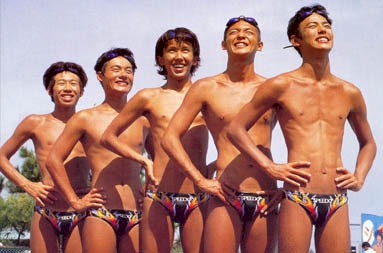
Drummer Olsson was charged by his English teacher to connect a book assigned in class to a piece of artwork. For dramatic purposes of this essay, the project was worth ONE HUNDRED PERCENT OF HIS GRADE!!!! but in reality was probably just some bullshit busy work. The novel Olsson chose was Whale Talk, one of several swim-team based tales of auteur and therapist Chris Crutcher.
According to Amazon.com, Whale Talk is the tale of a half black, half Japanese, all funny and wise-beyond-his-years high schooler named T.J. who with the help of English teacher Mr. Simet assembles a swim team full of misfits in order to somehow get back at a bully. While forming deep bonds with each of his diverse team mates, he also finds time to befriend a bi-racial girl from an abusive family, securing Whale Talk’s place in that ever-expanding canon of modern "coming of age" novels aimed at suburban teens.
The key to understanding The Lost Whale Sessions is to recognize that Olsson never intended on reading this derivative piece of shit. In order to relate the book to a work of art, he enlisted the members of Intergalactic Prophylactic to write an entire album ABOUT 'Whale Talk', or, in reality, what he believed the book to be about based on his understanding of its Amazon.com synopsis, which he barely bothered to read. He would then write an essay showing the many connections between Whale Talk the book and Whale Talk the album.
My God… it was… it was just crazy enough to work.
There exist many inconsistencies between the book and the album, such as the fact that the book's protagonist, T.J., appears only on the album as a vague character named "Whale Boy" who is half human and half whale, an obvious misrepresentation of T.J.’s multiracial background. On track 6, Troubled Past, Whale Boy reveals that he is the son of a "very loving mother" and a "vengeful ghost" who cursed him by turning him into half a whale. This information has absolutely no tangible connection to the novel, and was clearly made up on the spot by the musicians. Furthermore, while the swim team does play a central role on the album, its meaning and symbolism are entirely confused and plainly based on conjecture, and the character Mr. Simet – a positive character in the novel – is reimagined by vocalist Crowe as a seething psychopath prone to calling Whale Boy a “son of a bitch”. There are multiple other characters portrayed on the album, all of whom either violently berate Whale Boy or sexually proposition him; none of whom have any precedent in Crutcher’s book.
The aesthetics of LWS show a unique shift from the polished, if somewhat grubby production of EP Freely. The tracks of LWS make no attempt to hide the improvised nature of the album, with the number of takes enunciated before songs, studio chatter audible in the background, and profuse giggling on the part of Weeks every time Crowe starts cursing. Spontaneity, therefore, is embraced and centralized on this album, a motif that would drive later, more baffling Dickcore projects. Concurrently, the album also marks the first of several expansions of the Dickcore community, with the addition of All Star Jam Band guitarist Mike “Mountain Mike” S, who mans the strings on several tracks, and other All Star Jam Band guitarist Alex "Al-Dicks" Brown, who hovered around and drooled on things. Finally, it takes the narrative concept of Tribute to 1776 and extends it over the course of an entire LP, a feat that would be unsuccessfully reattempted numerous times by a variety of Intergalactic Prophylactic incarnations.

The Songs
Whale Talk

The album launches into its pseudo-narrative with Whale Talk, an impromptu version of Louie Louie, marked by guitarist Weeks shouting the lyrics "Whale Talk! / Whale Talk!" for a minute or so, hoping for someone else to chime in, before abandoning the vocals entirely. After thirty seconds of Olsson and Crowe aimlessly providing rhythm, Weeks steps in with some preposterous shredding and puts the song to sleep. This track, complete in its inanity, intimates that though this album is indeed more focused than its predecessor, it is irrevocably infused with absurdity.
Join The Team

We abruptly learn of Whale Boy’s conflict in the forceful Join the Team, in which he is presented, by a furious, anonymous narrator, with the decision of "join[ing] the swim team / or not", and then promptly told, "either way you are a cocksucker". An expansion upon earlier existential themes found in works such as Why Am I Michael Bluth?, the utilization of an extremely biased and vulgar narrator serves as an acknowledgment of the subjectivity of storytelling, and the track speaks worlds of the ambiguity and often stultifying nature of choice. For no matter how we choose, aren’t we in the end, just "cocksuckers"? In the world of Whale Boy, we most certainly are.
I'll Do It

Whale Boy suddenly becomes the narrator in I'll Do It, a compelling composition in which the protagonist declares his intentions of joining the swim team and overcoming his past by embracing his identity, "You know, I might have been a cocksucker in the past / But I’ve changed my ways! / I’m a new boy / A whale boy!" We are also introduced to the belligerent Mr. Simet, who immediately puts down his dreams with a curt, "You’re not gonna get anywhere boy, / You’re a son of a bitch! / You’re a motherfucking son of a bitch!" For about three months in 2005 this was the most played song on my Itunes.
Building a Team

This central conflict is interpreted as a militaristic endeavor in Building a Team, a simple, hammering march that defines Whale Boy’s mission “to build the best / swim team in the land”. Upon embarking on this task, Whale Boy receives briskly disparaging and overenthusiastically encouraging responses from two unnamed characters, launching him into the ambiguous second act of his journey, as enunciated most candidly in Romantic Interest.
Romantic Interest

This cryptic track, the longest on LWS, is very much in touch with vagaries and ideologies of the Dickcore zeitgeist. On the surface it is a very "chill" track, in which Whale Boy entirely embraces his sensuality, having an interest in an unknown character, which could possibly be his “dad”, his “sister”, or “three different guys”. He also, for reasons that are left unexplained, smokes “a fat bong”.
This track can be interpreted as the first of many Dickcore commentaries on the concept of “chillness”, a self-indulgent contemporary male ideal that propels men to embrace a macho personality and be prolific in their sexual conquests, while remaining perpetually passive and neutral through the regular gratuitous use of marijuana. The socialized nature of this ideal is made apparent in the use of 2nd person narration, suggesting that Whale Boy would not arrive at this ideal a priori, but rather had to have it explained to him. Furthermore, connecting "chillness" to Whale Boy’s primal urges as symbolized by his innocent, wanton sexuality, suggests that "chillness" as a cultural idiom is imagined in such a way that it is assumed to be an inherent, fundamental aspect of a person. One who is not "chill" is perceived and classified as abnormal, lacking something fundamental to the chill majority.
The Dickcore movement stands in contrast to the Chill ideal by reveling in the filthy, violent subconscious whimsies of man, discarding all social ideals and norms. Romantic Interest serves to satirically unravel this constricting, frivolous contrivance through the blatantly vapid "chillness" of its lyrics, persuading the listener, and Whale Boy, to critically examine their lives and motivations, and arrive at more complex, authentic modes of being.
Or it could just be a song about Whale Boy fucking people and getting high, which of course never takes place in the novel.
Troubled Past

From this song we move into the musical skit, Troubled Past, an imagined interaction between Whale Boy and his therapist. The pivotal moment of Troubled Past comes at song’s finale, in which the psychiatrist character suddenly invites Whale Boy to join him in the men’s room. While Intergalactic Prophylactic songs had flirted with subtle, humorous notions of homosexuality on previous endeavors, this track embraces it and exploits Western fears of gay sex for comic effect. The abrupt turn towards gayness, or at least, very caricatured gayness that has little connection to reality, gets to the roots of Dickcore as expressed in Intergalactic precursor, the All Star Jam Band, that is, the inducing of discomfort in the listener.
No Turning Back

Righteously Misunderstood

We Did It

On the rest of the album, Whale Boy explores the nature of his identity, assumes a moral stance on his alienation from society (Righteously Misunderstood), and takes “a fat shit” on the chests of his detractors, while I.P. engage in a memorable, incoherent rendition of “Two Princes” by the Spin Doctors. The journey of Whale Boy ends, without explanation, on a high note in the revelry of We Did It. Never one to forego absurdity, Crowe seals the album, in its final seconds, by bluntly stating, “Whale Boy sucks my asshole”.
While LWS can be understood as a continuation and expansion upon existing Dickcore models through a narrative structure, to only focus on its meaning within the Dickcore movement is to neglect the true reason for its existence: the Super Big English Class Essay Project!!!! In a dramatic race against time, Kevin took the album he had just completed, and wrote an essay – presumably a very self-referential one – that connected it to 'Whale Talk', the album’s inspiration. Along with his essay, Kevin turned in the Lost Whale Sessions in their entirety. The game was set.
While the bureaucratic intricacies of San Ramon Valley High School’s English department are steeped in mystery, what we do know, for purposes of explicating the Lost Whale Sessions, is that upon receiving Kevin’s project, reading his essay and listening to the album, his instructor was so moved (either by disgust or awe) that she played it for an assemblage of faculty members from the English department. The following image, to me, is the ultimate triumph of the Lost Whale Sessions: A group of college-educated adults… teachers… sitting in their break room between classes, listening to an album on which Chris Crowe, in an extremely silly voice, calls an imaginary whale/man hybrid a “filthy cocksucking son of a bitch”. Dickcore had officially hit the big time.

NYPD: New York Penis Department
The NYPD EP, easily the most accessible, straightforward Intergalactic Prophylactic emission, represents the pinnacle of Dickcore production values, and the first conscious examination of Dickcore values through the stylistic approaches of mainstream music, i.e. funk, blues, and rock. While little is added to the conceptual canon of Dickcore in this EP, precedents from earlier works – buggery, bestiality, patriotism, and gratuitous genital imagery – are expounded upon and given archetypal forms that would influence subsequent recordings. To paraphrase Winston Churchill, one thousand years from now, Dickcore scholars may look back at NYPD: New York Penis Department and still say, “This was Dickcore’s finest hour”. Or maybe they’ll be more partial to the I.P. work, Dickatron 5000 as it will resonate with their world of phallic spaceships and pedophilic robots (this album will be explained in Part IV of the Dickcore series). Or maybe they’ll just think we were a bunch of fags.
1776 Revisited...
The EP sets off from familiar territory with a revamped, more succinct version of Tribute to 1776 from the first I.P. production, EP Freely. Like the album’s titular homage to the heroes of 9/11, the choice of refurbishing such a patriotic song reflects the deep commitment of the Dickcore community to American values, and brazen nationalism. Such machismo and bravado is quickly scuttled by the second song.
Centaur Loving
Centaur Loving takes us, quite vigorously, into a funk-founded mythical world of salacious inter-species romance. Similar in form and philosophy to the earlier works Space Condom and Romantic Interest, it too beseeches its audience to look beneath the music and, through its idiotic lyrics, achieve a sense of personal growth. Whereas the earlier funk tracks force the listener to contemplate their place in the universe and society - by speaking of metaphorical phalluses and restrictive ideologies, respectively - Centaur Loving demands the listener to question themselves – specifically with the question, “Could I get it on with a centaur?” This reflects the running theme of disembodied sexuality in the Dickcore movement, where all forms of sex, gender, and love are presented as humorous ideas and constructions rather than as real entities or possibilities. This theme, and the horrendously unsubtle homoeroticism of the song’s lyrics – at one point needlessly highlighting the penile size of the eponymous Centaur – foreshadow the following tracks on the album, and literally every future work of the band.
Nothin' Like My Dick In Your Ass
As soon as Weeks’ saxophone sails off into the darkness at the end of Centaur Loving, we are savaged every which way by the jewel in the NYPD crown, Nothin’ Like My Dick In Your Ass, a blistering track unrivaled in its indifference to intrusive intercourse, its irrepressible rhythmic irreverence, and its insurmountable ickiness. A throwback to the principal movement in An Evening on Swan Lake, the paucity of its lyrics (only three verses stretched out over three minutes) and endless repetition of the song’s title both charm and frustrate the listener, getting their toes tapping and gag reflex gurgling, just in time for Mike S, the album’s guest guitarist, to ride roughshod over their sensibilities.
Foreskin Blues
S’s epic endeavor, Foreskin Blues, the final cut on NYPD, is a drowsy yet passionate, guitar-driven yet lyrically dense voyage that meanders through conceptual areas and realms of diction rarely exploited by the Blues genre. The song structure of Foreskin Blues is strictly traditional, but the direction in which Mike S manhandles the song are revolutionary – not only for its vulgarity, but for its commitment to abandoning any semblance of subtlety in favor of ostentatious offensiveness. Songs in the Dickcore genre would forever follow the path first traveled on tracks such as Foreskin Blues and Nothin’ Like My Dick In Your Ass.
NYPD: New York Penis Department cannot be overlooked. The catchiness and simplicity of the songs, when juxtaposed with their subject matter, shows that this is indeed a very radical piece of material. An effort on the part of Intergalactic Prophylactic to destabilize the musical world, it is truly an example of 21st century suburban agitprop (take that, Art majors!). NYPD takes the traditional forms of popular music and twists them in a distinctly Dickish manner. It is a masterpiece in senseless subversion, fighting the forces of popular music on behalf of a cause that nobody could ever bring themselves to support.
Yet alongside the many successes of the album, there were failures. Bassist Crowe, after penning the verses for Nothin’ Like My Dick..., left the band during the sessions to pursue video games and not spending his afternoons singing about dicks. Also, the notorious track Chinatown was lost after the NYPD sessions and never recovered. An extremely brief, reputedly “jazzy” piano piece, its only lyrics, “Going to Chinatown / With a dick in my butt”, this track surely would’ve become extremely influential in the movement, and would’ve been all sorts of fun to write an asinine analysis of.
In the next chapter of Dickcore: The Essential Essay Series, we will plunge into the murky, experimental depths of the second major Dickcore group: the alarming auditory awfulness of The Artists’ Co-Op and their sole contributions to the movement, The First Dick is Always Free, and Forty Dicks.
Labels: Chris Crowe, Intergalactic Prophylactic, Kevin Olsson, Mike, Tom Weeks
posted by Bertie P. @ 1:19 PM
0 Comments